
When Change Fails to Become the New Baseline

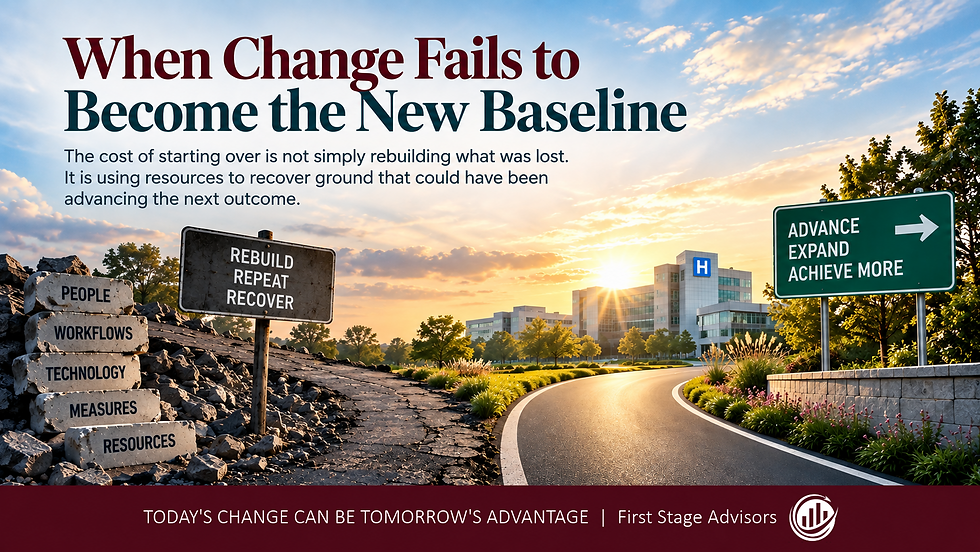
The cost of starting over is not simply rebuilding what was lost. It is using resources to recover ground that could have been advancing the next outcome.
At Health Connect South last week, a discussion about value-based care took me back more than a decade.
In 2012, I helped develop an Accountable Care Organization at a prominent academic health system. Value-based care was already reshaping how healthcare leaders thought about delivery, coordination, measurement, and reimbursement.
Fourteen years later, many of those same principles remain part of the conversation about where healthcare needs to go.
I had a similar reaction to discussions about changes accelerated during COVID. Healthcare demonstrated that it could make significant operational changes under extraordinary pressure. Some endured. Others receded as the circumstances, resources, and priorities that supported them changed.
None of this suggests that healthcare has failed to progress.
It does raise a different question:
Why do some healthcare innovations return years later as aspirations instead of becoming the foundation for what comes next?
When Improvement Is Driven by a Program
CMS programs offer a useful example. CMS identifies an area where performance needs to improve and establishes requirements and reimbursement incentives intended to move organizations toward a higher standard.
Healthcare organizations respond. They redesign workflows, allocate resources, build capabilities, collect data, measure performance, and make the operational changes necessary to participate.
The program creates both the requirement and the economic incentive for change.
At some point, however, participation in the program ends or its requirements evolve. The expectation is that much of the improvement achieved during the program has become embedded in normal operations. The next initiative can then build on that higher level of performance.
In principle, improvement becomes cumulative.
Each achieved outcome establishes a stronger baseline from which the organization can advance.
The Economics Do Not End with the Program
The operational reality is more complicated.
When the external incentive changes, the cost of maintaining the capabilities developed during the program does not necessarily change with it. People still cost money. Workflows still consume capacity. Measurement still requires resources. Technology still requires support. Processes created for the program continue to compete with other organizational priorities.
Leadership therefore reassesses what remains necessary and what continues to justify its cost.
Some components are retained because they remain tied to reimbursement, regulatory requirements, or other measurable value. Others may be reduced or eliminated because their continuing contribution is more difficult to quantify. Those decisions can be economically rational individually while producing a different result collectively.
The organization may preserve what is required without preserving all of what produced the higher level of performance.
Over time, some of the capabilities developed through the original initiative can erode.
The Next Program May Assume the Baseline Still Exists
The underlying objective has not gone away. Quality still needs to improve. Care still needs to become more coordinated. Access and affordability remain challenges. Patient outcomes still matter.
The next program is therefore designed to advance the work further.
It may have a different name, different measures, different technology, or a different reimbursement structure. But it often begins with an implicit assumption: previous improvements have become part of the operating baseline.
That assumption matters.
If portions of the earlier capability have been dismantled, the organization may need to recreate them before it can move forward.
Resources return.
Workflows are rebuilt.
Processes are being reintroduced.
Capabilities developed under one initiative are reconstructed to satisfy the requirements of another. The organization is moving—but some of that movement is spent recovering ground it had already covered.
What was intended to be cumulative improvement becomes cyclical implementation.
Resources that could be advancing the next outcome are instead being used to rebuild capabilities the organization has already developed.
The End of the Program Is an Executive Decision Point
The alternative is not to preserve every component of every program. That would be neither practical nor desirable. Some processes should end. Others should evolve. Technology changes. Evidence changes. Economics change. A requirement that once created value may eventually create unnecessary burden.
The more important distinction is between evaluating a program and evaluating the capability and outcome the program created.
When the external requirement changes, leadership has an opportunity to determine what should happen to the value created during the initiative.
Which changes improved performance?
Which capabilities were essential to producing that improvement?
Which remain economically and operationally valuable after the external incentive changes?
Which should become part of the organization's ongoing operating baseline?
Those decisions determine whether the organization carries the value of the initiative forward—or eventually must rebuild it.
The Return Can Extend Beyond the Original Initiative
There is another dimension to that evaluation. An initiative frequently creates capabilities that have value beyond the problem it was originally designed to address.
A new workflow may reveal a more effective way to manage another patient population. Better information flow may improve decisions elsewhere in the organization. New measures may expose opportunities outside the original operating area. A different way of coordinating across functions may prove useful for initiatives that did not exist when the capability was developed. Those opportunities are easy to miss when the organization evaluates the initiative only against the requirements that created it.
The more valuable question is broader:
What can the organization now do better because of what it learned and built?
That changes the economics of sustainment. A capability that appears difficult to justify against the original program alone may have greater organizational value when its broader applications are understood. And an outcome that initially represents the successful conclusion of one initiative can become the starting point for several others.
That is where the return on change begins to extend beyond the investment that created it.
From Individual Initiatives to Organizational Capability
This is also where the discussion moves beyond individual programs. Organizations will always respond to external requirements. Healthcare is too regulated, financially constrained, and operationally complex for that to change.
The larger question is what the organization retains from each response. If the knowledge, operating practices, relationships, and capabilities developed through an initiative remain attached only to that initiative, their value is vulnerable when the initiative ends.
W
hen leadership evaluates them as organizational assets, the calculation changes. The organization can determine what should be retained, what should be adapted, and where proven capabilities can create additional value.
Over time, those decisions accumulate. The organization is not simply completing a succession of initiatives. It is building an increasingly capable operating environment from the outcomes of the initiatives that came before.
Successful change becomes an input to the next change.
Building Rather Than Rebuilding
Healthcare has no shortage of innovation. The more consequential question is how much of the value created by that innovation becomes part of the organization's capacity to perform at a higher level. The distinction matters.
A completed initiative demonstrates that an organization can execute a defined body of work.
An achieved outcome demonstrates that the work produced value.
A sustained outcome establishes a new operating baseline.
And the ability to apply what was learned beyond the original initiative allows that value to expand.
That progression does not occur automatically when a program ends. It reflects repeated executive decisions about what the organization will retain, where it will continue to invest, and how it will use capabilities it has already paid to develop.
Those decisions ultimately shape more than the performance of an individual initiative. They shape how the organization responds to change. Because the purpose of an initiative is not successful completion.
It is an outcome worth achieving, sustaining, and building upon.
When building on successful outcomes becomes part of normal executive discipline, the organization is no longer relying on each new program to recreate the momentum for improvement. It is carrying that capability forward.
That is when alignment around an initiative begins to become alignment as a culture.



Comments